Practical Ways to Cut Costs on LLM API Calls
Understanding Where Your Costs Come From
When you build applications around large language models, the cost of API calls can climb quickly. Most developers start with a simple mental model: one call costs a certain amount, and scaling up multiplies that. But the real picture is more detailed. The price you pay depends on the number of input tokens you send to the model, the number of output tokens it returns, and the specific model you choose. Each provider sets its own rates for these token categories, and those rates vary widely. If you are not tracking your usage at the token level, you may be spending more than necessary without knowing why.
The first step in lowering costs is understanding how your application uses tokens. Input tokens include your prompt, any context you pass, and the instructions you give. Output tokens are the model's response. Some tasks, like summarization, use far more input tokens than output tokens. Others, like creative writing, may generate long responses from short prompts. By profiling your requests, you can see where the bulk of your spending goes. Then you can decide which lever to pull: reduce the number of tokens, switch to a cheaper model, or change how you structure your calls.
Start With a Smaller Model When Possible
Not every task requires the largest, most capable model. For many common jobs - classification, simple extraction, short-form generation - a smaller model performs almost as well at a fraction of the price. The trade-off is that smaller models may need more careful prompting or a few more attempts to match the quality of a bigger one. But the savings can be substantial. If you are building a system that handles thousands of requests per day, even a small difference in token pricing per call adds up fast.
The key is to match model capability to task difficulty. For example, if you are routing user queries to different handlers, a lightweight model can decide the category. Save the expensive model for tasks that genuinely need its reasoning depth, such as complex analysis or multi-step instruction following. Many providers offer a range of model sizes, and some even let you set a fallback: try the cheaper model first, and if the confidence score is too low, escalate to the larger one. This tiered approach can cut costs without sacrificing quality on the harder problems.
Cache and Reuse Common Responses
A large portion of LLM API calls in production are repetitive. Users may ask the same questions, or your application may generate similar outputs for similar inputs. If you can cache the results of common requests, you avoid paying for the same computation twice. This works especially well for static content: FAQ answers, product descriptions, or any lookup that does not change frequently. The trick is to design a cache key that captures the essence of the request without being too narrow. A hash of the prompt and a few key parameters is a good start.
Another possibility is to use a shorter context for repeated calls. If your application includes a long system prompt that rarely changes, you can store the model's initial response to that prompt and reuse it. Some providers offer a "session" mode where the model remembers context across turns, which can reduce the number of tokens you need to send each time. But be careful: sessions can also accumulate context and grow expensive if you do not manage their length. Set a maximum context window and reset it periodically.
Bundle Requests and Batch Process Them
Many LLM APIs allow you to send multiple requests in a single batch. Instead of making ten separate calls with ten separate prompts, you can send one call with ten prompts inside it. The provider processes them together and returns an array of responses. Batching saves on overhead and often reduces the per-request cost because the provider can optimize its internal computation. It also cuts down on network latency, so your application can handle higher request volume without slowing down.
The trade-off is that batching introduces a small delay while the provider collects enough prompts to fill a batch. For real-time applications, this delay may not be acceptable. But for background jobs, nightly reports, or any task that can wait a few seconds, batching is a straightforward way to lower costs. Some providers even offer a discount for batch processing, so check the documentation for your chosen API. If you are using a cheap AI model API that supports batching, this feature alone can make a noticeable difference in your monthly billing balance.
Monitor Token Usage Actively
Cost monitoring is not a one-time setup. It should be an ongoing practice. Set up logging for every API call: record the model used, the number of input and output tokens, the time of the request, and any relevant metadata. Over time, this data reveals patterns. You might discover that a certain endpoint is using far more tokens than expected, or that a particular model is being called for tasks that a cheaper alternative could handle. With this information, you can adjust your routing logic or switch models.
Many providers offer dashboards that show your usage and spending in near real time. Use them. Set alerts for when your spending exceeds a threshold, so you catch problems early. If you are working with a team, establish a policy for reviewing token usage each week. Small inefficiencies that go unnoticed can accumulate into large bills. By staying on top of your usage, you keep the costs predictable and avoid surprises at the end of the month.
Shop Around for Better Rates
The market for LLM APIs is competitive, and prices change frequently. The model that was the best deal last quarter may no longer be the cheapest. It pays to compare the token pricing of different providers. Some offer lower rates for high-volume customers. Others have special pricing for non-commercial or research use. And some third-party services aggregate multiple models behind a single API, giving you access to lower model rates by routing your requests to the cheapest available provider at the moment.
When you evaluate a new provider, look beyond the list price. Consider factors like reliability, latency, and the quality of the model's outputs. A slightly higher price may be worth it if the provider offers faster responses or better accuracy for your use case. But for many applications, the difference in quality is small enough that the cheapest option is the right one. If your application can tolerate minor variability in output, you can save significantly by using a cheap AI model API that still meets your requirements.
Optimize Your Prompt Structure
The way you write your prompts directly affects the number of input tokens. Long instructions, verbose examples, and unnecessary context all add to your cost. Spend time refining your prompts to be as concise as possible while still getting the desired output. Use clear, direct language. Remove redundant phrases. If you include examples, keep them minimal. Every token you trim from your prompts reduces your spending.
Similarly, consider the length of the responses you request. If your application only needs a short answer, ask for it explicitly. You can instruct the model to "respond in one sentence" or "keep the answer under 50 words." This reduces output tokens. Some APIs allow you to set a maximum output token limit, which prevents the model from generating long responses when a short one would do. Set that limit to a reasonable value for each type of request. It is a simple change that can have a big impact on your total token usage over thousands of calls.
One effective technique is to break complex tasks into smaller steps. Instead of asking a single model call to perform a multi-step analysis, you can chain several smaller calls, each with a focused prompt. The total number of tokens may be higher, but because you can use a cheaper model for the simpler steps, the overall cost can be lower. Experiment with different breakdowns to find the sweet spot for your application.
Use a Provider That Aggregates Models
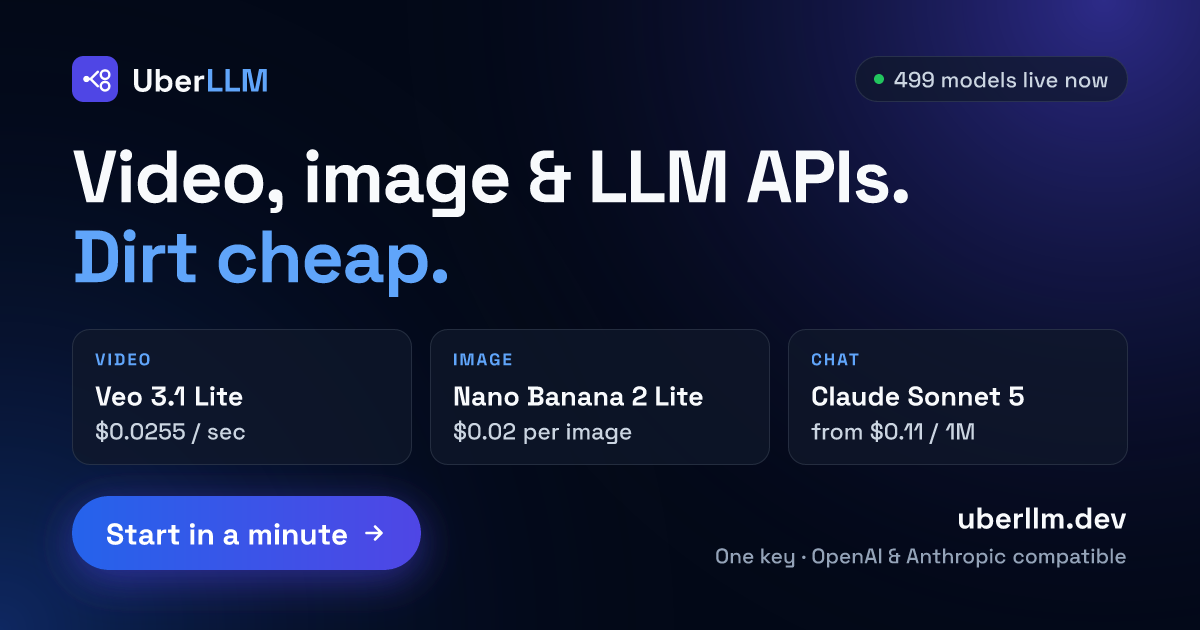
Managing multiple API keys and billing accounts for different providers is a hassle. A more efficient approach is to use a single API that routes your requests to the cheapest available model from a pool of providers. This kind of service gives you access to lower model rates without requiring you to sign up for each provider individually. You get the flexibility to switch between models as prices change, and you only need to manage one integration and one billing balance.
These aggregators often negotiate volume discounts and pass the savings along. They also handle the complexity of monitoring each provider's uptime and latency, so you can focus on building your application. For a team that needs to control costs without adding operational overhead, this can be a practical solution. Just be sure to check that the aggregator supports the models you need and that its API is compatible with your existing code. Many offer an OpenAI or Anthropic compatible interface, which makes the switch straightforward.
Reducing the cost of production LLM API calls is not about finding a single magic trick. It is about a combination of practices: choosing the right model for each task, caching where possible, batching when it makes sense, monitoring your usage, and shopping around for favorable rates. Each of these steps alone may save a modest amount, but together they can reduce your monthly spending significantly. Start with the ones that are easiest to implement in your current setup, then gradually add the others. Over time, you will build a cost-efficient pipeline that lets you scale your application without letting costs run away.